CVSI | Verified Movement & Predictive Safety Intelligence for transportation operators Request a Pilot →
CVSI · Verified Movement Safety Intelligence

Verify every movement. Predict every risk.

Cruze builds safety technology for mobility operators. CVSI is the B2B verified movement safety intelligence platform behind Cruze Rideshare — now available to license.

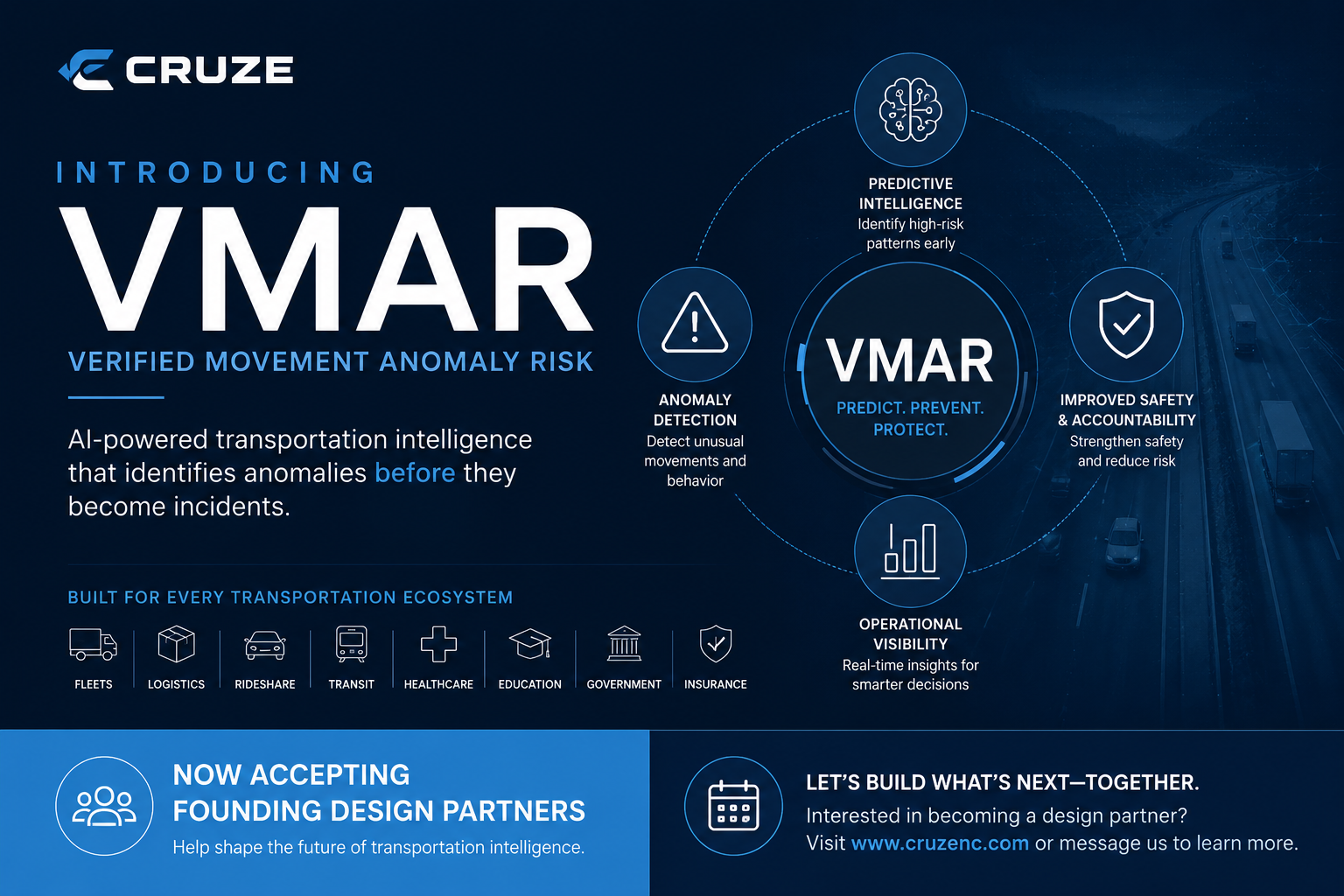
VMAR overview: predictive intelligence, anomaly detection, operational visibility, and improved safety and accountability across transportation ecosystems.

An API-first verified movement & predictive safety intelligence platform

CVSI by Cruze verifies whether the right person, vehicle, asset, assignment, route, location, timing, and handoff matched what was supposed to happen — then generates explainable risk scoring, tamper-evident evidence records, and human-review reports. Cruze Rideshare is our safety-first operating platform; CVSI is the safety-intelligence layer that can be licensed to any mobility operator.

Verify. Score. Preserve evidence.

Every movement event — from any capture method — is normalized, verified, scored, and recorded.

1 — Verify the movement

Confirm people, vehicles, assets, assignments, routes, locations, timing, and handoffs against what was scheduled — using PIN, QR, NFC, or token-based challenges, with optional geofencing, configured per vertical.

2 — Assess risk

CVSI produces an explainable risk assessment with reason codes, confidence, and a recommended action.

3 — Preserve evidence

Each scored event writes a tamper-evident evidence record and a human-readable report you can review and export.

A hosted API, not a science project

CVSI is fully hosted — there's no infrastructure to stand up, and most teams complete a first integration in days.

Documented REST API, typed SDK

A versioned REST API plus a typed TypeScript/Node SDK (@cruze/cvsi-sdk), with an OpenAPI spec available for teams on other stacks.

Start testing today

A test API key works immediately — no sales call required. Verify the integration end-to-end before a live key or contract is ever on the table.

Signed, reliable webhooks

Real-time delivery with signed payloads and a self-test endpoint, so your team can verify signature handling before going live.

Verifies vehicles, assets, and handoffs — not just people

Signed, revocable vehicle tokens

Rotating QR/VIN tokens with revocation and assignment matching confirm this vehicle is authorized for this operator, right now.

Statistical, explainable outliers

Zone- and time-based anomaly detection flags unusual movement patterns — advisory and explainable, never a black box.

Built for freight, not just people

Load and handoff verification with cold-chain exception flagging for logistics and freight operators moving goods.

Built for safety-sensitive mobility operators

NEMT

Non-emergency medical transport proof-of-service: verify patient, appointment, vehicle, pickup, and dropoff.

Rideshare safety

Verified boarding for the correct operator, vehicle, and passenger before every trip begins.

Campus mobility

Verified shuttle and campus transport with location- and time-anchored records.

Logistics & freight

Chain-of-custody handoffs, load verification, and route/assignment matching.

Public transit & paratransit

Assignment, route, and handoff verification for scheduled and demand-response service.

School transportation

Verified boarding, route, and stop matching for school bus and student transport programs.

Rail & restricted-access transit

Assignment and access verification for rail crews and restricted-access transit environments.

Corporate shuttle programs

Verified passenger boarding and route adherence for employer and corporate shuttle programs.

Delivery & courier

Verified pickup and drop-off for food, package, and courier delivery operators.

Physical security

Verified guard check-ins and patrol route confirmation for physical security operations.

High-value asset custody

Our strictest policy template — every factor gates and geofencing is required for high-value asset transfer custody.
Tenant-isolated, privacy-first, enterprise-ready

Hard tenant boundaries

Every tenant's data is scoped at the data layer. Cross-tenant access attempts fail closed with a plain not-found — not a distinguishable error to probe against.

Pseudonymous by default

CVSI verifies against tenant-controlled, pseudonymous identifiers — it doesn't need to hold raw personal data to do its job. Optional field-level encryption is available for sensitive fields.

API keys or enterprise SSO

Standard integrations use scoped API keys. Organizations that require it can add enterprise SSO (OIDC bearer auth) alongside them.

What partners ask before they integrate

What does onboarding actually look like?
Register, get a free sandbox key immediately, and pick a policy template for your vertical with our help. A one-click email verification unlocks a live key once you've run a full round-trip on the test key. You'll name a reviewer and a response SLA before going live. Legal paperwork runs in parallel and doesn't block the technical work.
Can we test CVSI before signing anything?
Yes. A test API key works immediately — no sales call required. Live keys unlock after a one-click email verification.
How does pricing work?
Usage-based, tied to verified events, with a free sandbox tier to start. We don't publish list pricing — enterprise plans are quoted directly based on volume and vertical.
What verification methods are supported?
PIN, QR, NFC, and token-based challenges, with optional geofencing — configured per vertical through policy templates.
What happens when CVSI flags something?
Every score ships with explainable, human-readable reason codes from a published catalog. Elevated or review-required events route to a named human reviewer — CVSI never takes automatic adverse action against a person. That's a platform guarantee, not a setting.
What's actually validated today?
The core verification and scoring engine runs in production today inside Cruze's own rideshare app, and has been validated against synthetic alpha datasets across every supported vertical. We do not yet claim independent, third-party, or external-operator validation — proving that out is the explicit purpose of our paid pilot program.
How long does integration take?
Most teams complete a standard integration with one backend engineer in a few days, using our REST API, typed SDK, and signed webhooks. CVSI is fully hosted, so there's no infrastructure to stand up.

Controlled paid pilots

We are running controlled paid pilots with NEMT and other safety-sensitive operators: a controlled dataset, explainable reports, named reviewers, and no automatic adverse action. The underlying engine already verifies live traffic inside Cruze's own rideshare app — but we do not yet claim independent, third-party, or external-operator validation. That's what the pilot program exists to prove.

Apply for a pilot

Talk to the Cruze team about a CVSI pilot, integration, or licensing for your operation.